Starting a junk removal business requires three things: a truck, basic equipment, and 72 hours to get your first paying customer. You can launch with as little as $2,000 if you already own a pickup truck, or go the full route with a $25,000 box truck for higher capacity.
Steps to start a junk removal business:
- Calculate your real startup costs
- Choose your vehicle setup
- Master disposal logistics and find local transfer stations
- Handle legal requirements (LLC, insurance, permits)
- Set volume-based pricing that actually makes you money
- Get your first customers through free marketing channels
Skip the business plan - focus on logistics and pricing that protect your profit, and legal setup you can finish this weekend.
Is a junk removal business profitable?
Yes. A well-run junk removal business can hit 50% profit margins [what you keep after all costs] on solo jobs and 20-30% with a crew.
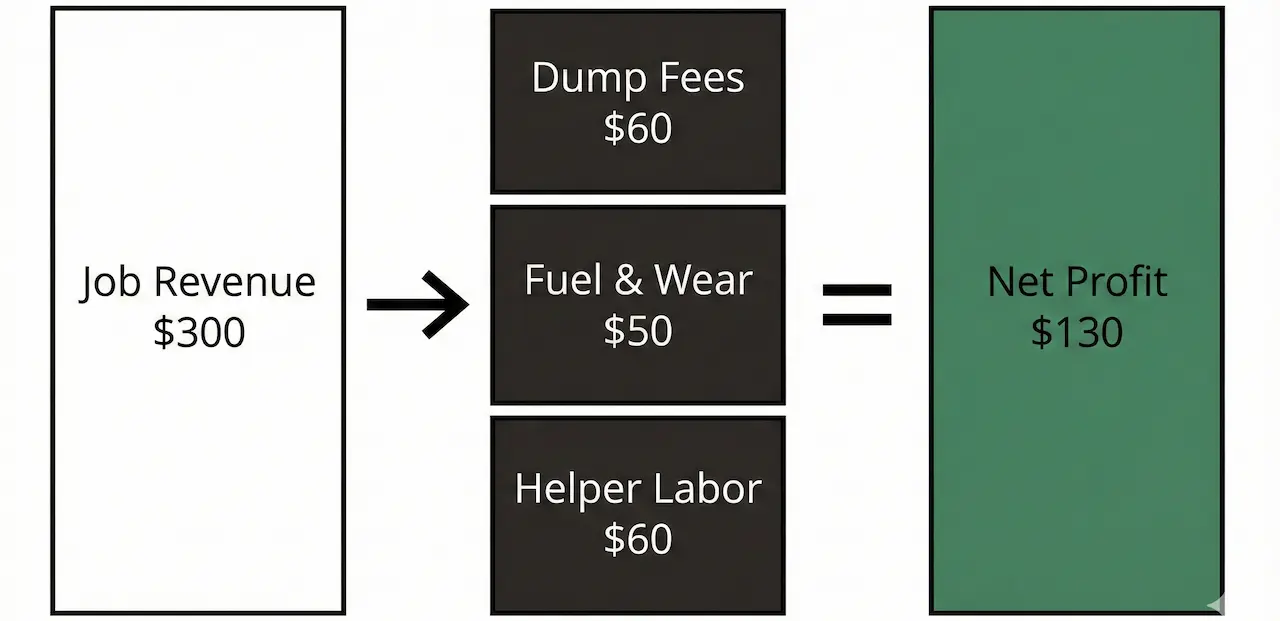
The math on a typical $300 residential cleanout job:
- You charge $300 to haul a half-truck load of furniture and boxes.
- Your costs: $60 in dump fees at the transfer station, $20 in fuel, $30 in vehicle wear (tires, brakes, maintenance fund).
- Total hard costs: $110.
- You make $190 before labor.
Run the job solo in three hours (one hour loading, 30 minutes driving to the dump, 30 minutes unloading, one hour driving back and invoicing), and you're making $63 per hour.
Hire a helper at $20/hour for three hours and your labor cost jumps to $60. Now your profit is $130 on the same $300 job. Still good, but the labor factor cuts deep.
The difference between breaking even and making real money in the junk removal business comes down to volume estimation (quoting a job accurately), efficient routing (not burning fuel on backtracking), and knowing when to say no to jobs that don't pay. Heavy loads like concrete or appliances cost more to dispose of and take longer to move. Light loads like cardboard or yard waste stack high but weigh nothing. You need to know which is which before you quote.
The junk removal industry generates over $10 billion annually in the U.S., and demand stays consistent regardless of economic conditions. People always need stuff hauled away.
Is junk removal a good side hustle?
Yes, if you already own a truck. With a truck, the startup costs are low enough that you can test your business on weekends without quitting your day job. It’s one of the most accessible service business ideas to launch quickly.
Run five jobs, track your real costs, and see if the math works for you in your area before going full-time.
Step 1: Calculate your junk removal business startup costs
Your junk removal business startup budget depends on what you already own and how fast you want to grow. There are two realistic tiers: the bootstrapper budget and the pro budget.
The bootstrapper budget ($2,000–$5,000)
You already own a pickup truck. Here's the other items you need:
- 6x12 utility trailer: $1,500–$2,500
- General liability insurance: $500–$800/year
- Basic equipment (tie-down straps, heavy-duty dolly, work gloves, first-aid kit): $300–$500
- LLC registration: $100–$300 depending on your state
- Website and invoicing system: $30/month through an all-in-one platform
- Marketing: Free (Craigslist, Facebook Marketplace)
Total first-year cost: $3,500–$6,000
The pro budget ($20,000–$40,000)
Buy your own truck and go bigger. Here's the breakdown:
- Used 14-foot box truck (100,000 miles): $15,000–$25,000
- Commercial auto insurance: $2,000–$3,000/year
- General liability insurance: $800–$1,200/year
- Maintenance reserves: $2,000
- Professional signage, custom website with local SEO, paid advertising
- LLC registration: $100–$300
Total first-year cost: $25,000–$45,000
Hidden costs for new junk removal business owners
These surprise costs can add $1,000–$2,000 to your startup budget, so factor them in early.
Commercial insurance deposits: Your insurance company will often ask for two months of payments upfront when you start your policy (more on this in Step 4).
Vehicle registration and DOT numbers: If you're hauling junk across state lines to dump it, you may need to register as a commercial vehicle and get a Department of Transportation number - this involves inspections and paperwork.
Transfer station deposits: Many dump sites require you to open an account with a security deposit ($500 - $1,000) before they'll accept your loads. Call ahead.
Avoid taking on too much debt
Try the bootstrap budget and prove to yourself that junk removal is the right business for you before you take on debt. Run 20 jobs with the trailer setup and track your real costs per job. If you’re able to make enough money and you're turning away work because you lack capacity, then upgrade to a bigger rig. Cash flow beats debt every time in this business.
Don't finance a $40,000 truck before you've proven you can book jobs consistently and quote them accurately. The graveyard of failed junk removal businesses is full of operators who bought too much vehicle too soon and couldn't fill it.
Step 2: Choose your vehicle: truck vs. trailer
Your vehicle choice determines your capacity, your operating costs, and how much pain you're willing to endure at the dump. There's no perfect answer, only trade-offs.
Pickup truck + utility trailer
This is the bootstrapper's setup. Spend $1,500–$2,500 on a 6x12 or 7x14 enclosed or open trailer and tow it behind your existing half-ton pickup.
The upside: low initial investment, and you can unhitch the trailer and use your truck for personal errands. The downside: you're backing a trailer into tight driveways, and unloading at the dump means dragging everything out by hand because trailers don't have hydraulic lifts. A full trailer can take 45 minutes to unload at a transfer station.
Check your truck's towing capacity before you buy. A Ford F-150 with the max tow package can handle 8,000–13,000 pounds depending on the year and engine. Overload it and you'll blow a transmission.
Box truck (14–16 feet)
This is the workhorse for most junk removal businesses. Buy a used Isuzu NPR or similar for $15,000–$25,000 with 80,000–120,000 miles on it.
The upside: massive volume (you can fit a whole house cleanout in one trip), professional appearance, and easier loading because the bed is waist-high. The downside: no hydraulic dump, so you're still unloading by hand. Fuel economy is terrible (8–10 mpg). Parking can be difficult in residential neighborhoods. Maintenance is expensive — these are commercial diesels, not consumer trucks.
Dump truck
This is the gold standard for junk removal businesses if you can afford it. A used single-axle dump truck (think F-550 or similar) runs $25,000–$50,000 depending on mileage and condition.
The upside: you load it once and dump everything in 60 seconds by raising the hydraulic bed. No hand-unloading. Your back will thank you. The downside: higher purchase price, worse fuel economy than a pickup, and you're limited to loose loads (furniture doesn't stack well in a dump bed).
Best for contractors doing demolition debris, not ideal for residential furniture removal.
Rental trucks for peak season
If you're bootstrapping and hit a busy week, rent a 16-foot box truck from Penske or Budget for $150–$200/day. This lets you take bigger jobs without committing to a purchase.
Some operators run a pickup + trailer full-time and rent a box truck for commercial cleanouts or estate sales.
Most successful solo junk haulers start with a pickup and trailer, then upgrade to a box truck within six months when they're turning away work. Don't skip the bootstrapper phase. A $25,000 box truck sitting empty in your driveway is just an expensive lawn ornament.
Step 3: Master junk removal business logistics: disposal and recycling
Knowing where the junk goes is just as important as knowing how to haul it. Your disposal strategy determines your costs, your margins, and whether you're dumping legally.
Landfill vs. transfer station
Most junk removal operators use transfer stations, not landfills directly.
A transfer station is a sorting facility where waste gets consolidated before heading to the landfill. You pay a tipping fee based on weight - typically $40–$80 per ton depending on your region. East Coast and West Coast markets run higher ($70–$100/ton), while Midwest and South run lower ($30–$60/ton).
Weigh your truck empty, weigh it full, pay for the difference. Some stations charge a flat $50 minimum even if you're under a ton.
Green disposal and donation arbitrage
Before you dump everything, pull out items that donation centers will take.
Goodwill, Habitat for Humanity ReStores, and Salvation Army will accept working furniture, appliances, and household goods. You get a tax write-off for the fair market value of donated items (save receipts), and you avoid tipping fees on that weight.
Some operators run a "green junk removal" marketing angle and charge a premium to customers who want eco-friendly disposal.
Scrap metal arbitrage
Separate copper wire, brass fixtures, aluminum, and steel before you dump.
Scrap yards pay by weight - copper fetches $3–$4/pound, brass $2–$3/pound, aluminum $0.50–$0.80/pound. A water heater has 3–5 pounds of copper and 30–40 pounds of steel. Appliances have motors with copper windings. Car batteries pay $10–$15 each at scrap yards.
On a good cleanout, you can pull $50–$150 in scrap value that offsets your dump fees. Keep a separate bin in your truck for metals.
Hazardous waste no-go list
Do not accept or transport:
- Paint
- Chemicals
- Asbestos
- Batteries (except car batteries to scrap yards)
- Medical waste
- Propane tanks
Transfer stations will reject your load and fine you if they find hazardous materials. Some states impose $10,000+ penalties for illegal dumping. If a customer insists you take paint or chemicals, direct them to their county's household hazardous waste collection program and charge an extra fee to deliver non-hazardous items only.
The sorting technique
Pack your truck strategically. Metals in one corner, donatables in another, pure trash in the middle. When you arrive at the transfer station, pull the recyclables and donations first, then dump the rest. This saves time and money because you're not paying tipping fees on items you can make money on elsewhere.
Beginners dump everything in one trip and wonder why they aren’t making money. Junk removal company owners who master the logistics - sorting, recycling, donating - can shave 20-30% off disposal costs, which goes directly back in your pocket.

Step 4: Handle the legal requirements
The legal setup for a junk removal business is lighter than most service businesses, but cutting corners here will cost you later (so don’t).
Business structure
Most junk removal business operators start as a sole proprietor or LLC.
An LLC protects your personal assets if a customer sues you for property damage or injury. It costs $100-$300 to file depending on your state and takes 2–4 weeks to process.
You don't need an LLC to take your first job, but get one filed before you grow. Use a registered agent service (a company that receives legal mail on your behalf) if you don't want legal or business mail showing up at your home address.
Insurance
You need two policies.
General liability insurance covers property damage and injuries at job sites. If you scratch a hardwood floor while hauling a couch, general liability pays for repairs. Expect $500–$1,200/year for $1 million in coverage.
Commercial auto insurance covers your truck and trailer while you're working. Personal auto policies specifically exclude commercial use, and if you file a claim after a job-related accident, your insurer will deny it. Commercial auto runs $2,000–$4,000/year depending on your driving record and vehicle value.
Don't operate without both policies. One lawsuit will bankrupt you.
Licenses and permits
Check your city and county for business license requirements. Most municipalities require a general business license ($50–$200/year) and some require a waste hauler permit ($100–$500/year).
If you're crossing state lines for disposal, you may need a U.S. DOT number (free to register, but requires vehicle inspections and log books). Call your local zoning office and ask what's required for waste hauling in your area.
Contracts and liability waivers
Use a simple service agreement for every job that includes a damage waiver. The waiver states that you're not responsible for pre-existing damage to driveways, doorways, or landscaping caused by moving heavy items through tight spaces. Have the customer sign before you load anything.
This won't prevent lawsuits, but it gives you a defense. A lawyer can draft a one-page template for $200–$500.
Step 5: Set your junk removal business pricing strategy
Pricing a junk removal job is part math, part experience, and part reading the load. Get it wrong and you'll work for free. Get it right and you'll hit 50% margins consistently.
Volume-based pricing structure
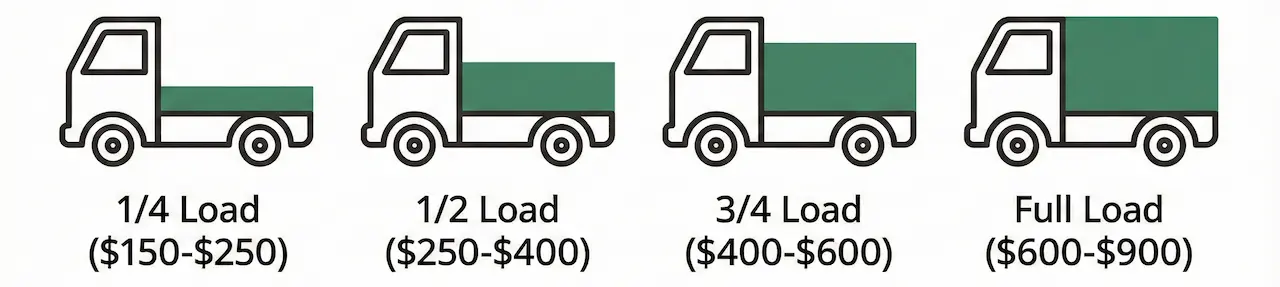
Most junk removal businesses charge by volume, not time. You quote jobs based on how much space the junk will take up in your truck. The standard tiers: 1/4 truck load ($150–$250), 1/2 truck load ($250–$400), 3/4 truck load ($400–$600), full truck load ($600–$900). These ranges vary by market - urban areas and coastal markets run 20-30% higher than rural Midwest markets. Your goal is to estimate volume accurately so you're not cramming $600 worth of junk into a truck you quoted at $300.
The pricing formula
Take your disposal cost per load and multiply it by 2 to 3, then add your labor rate. If your dump fee for a half-truck load is $60 and you spend two hours on the job at $50/hour for labor, your price should be ($60 x 2.5) + $100 = $250 minimum. The 2–3x multiplier on disposal covers fuel, vehicle wear, insurance, and profit margin. If you're running a crew, your labor rate jumps to $100–$150 for two people.
Heavy loads vs. high stacks
A bed frame and mattress might fill half your truck by volume but weigh 200 pounds. A load of construction debris — concrete, dirt, bricks — might only fill a quarter of your truck but weigh 2,000 pounds. You pay tipping fees by weight, not volume.
Example: a garage cleanout with five old tires, a rusted lawn mower, and some scrap metal might look like a $200 quarter-load job, but it weighs 800 pounds and costs you $40 in dump fees. Meanwhile, a bedroom cleanout with a mattress, dresser, and 20 boxes of clothes looks like a $350 half-load job but weighs 300 pounds and costs you $15 to dump.
Always ask what's being hauled before you quote. Charge extra for heavy loads ($50–$100 surcharge for appliances, $100–$200 for construction debris). Light loads like cardboard or foam padding stack high but cost almost nothing to dump.
The eye test
The fastest way to estimate volume is to look at the pile and visualize how it would fit in your truck bed.
A standard bedroom dresser plus queen mattress equals about 1/8 of a truck bed. A living room couch takes 1/6. A washer-dryer pair fills about 1/4. Use these as your mental measuring sticks until you've done 20 jobs.
Beginners overestimate volume (and leave money on the table) or underestimate it (and lose money when they can't fit everything in one trip).
Run 20 jobs and track your accuracy. Compare your quote to the actual space used. You'll calibrate fast.
Surcharges and add-ons
Charge extra for stairs ($25–$50 per floor), hazmat disposal coordination ($50 flat fee to direct them to proper disposal), same-day service ($50–$100 rush fee), and after-hours or weekend jobs ($100 premium). Don't negotiate these down. Your time and effort have value. If a customer complains, they're not your customer.
Avoid hourly pricing. Customers will nickel-and-dime you on time spent ("it only took you 90 minutes, why did you charge for two hours?"). Volume pricing is transparent and defensible. You quoted based on the junk, not the clock.
Get paid on time
You can use separate tools for your business setup (WordPress for your website, Wave for invoicing, spreadsheets for tracking jobs), or you can find a single platform that handles everything in one place. Durable combines your website, invoicing, and customer management so you're not juggling multiple logins while you're trying to haul junk. You quote a job over text, send the invoice from your truck, and get paid before you leave the driveway. Everything syncs automatically — no data entry, no missed follow-ups.
The faster you get your business looking legitimate, the more premium jobs you'll land. The quicker you get paid, the better your cash flow for gas and dump fees. Admin work isn't fun, but it's what separates profitable operators from guys who burn out after six months.
Step 6: Get your first customers
Marketing a junk removal business is less about brand building and more about showing up where people are already looking for help.
Soft launch on free platforms
Post on Craigslist under the "services > moving" section with a simple ad: "Junk removal and hauling. Same-day service. Call or text [number]." Repeat this every 2–3 days because Craigslist posts expire fast.
Join Nextdoor and introduce yourself in the "businesses" section of your neighborhood.
Facebook Marketplace and local buy/sell groups also work. The posts cost nothing and you'll get calls within 48 hours.
Set up Google Business Profile
Create a free Google Business Profile immediately. Most junk removal customers search "junk removal near me" on Google, and the map results dominate the first page (a.k.a. local SEO). Fill out every field in your profile - business name, phone number, service area, hours, photos of your truck. Ask every customer to leave a review after the job. Five-star reviews push you higher in local search rankings.
Expect 30-40% of your jobs to come from Google within six months if you're diligent about reviews and updates.
Bandit signs for immediate visibility
Print 50 corrugated plastic signs (18x24 inches) that say "JUNK REMOVAL" with your phone number in giant letters. Put them at busy intersections, grocery store parking lots, and near apartment complexes on Friday afternoons (when people are cleaning out for the weekend).
Some cities ban these signs and will fine you, so check local laws. Where it's allowed, expect 3–5 calls per weekend from signage.

Reach out to realtors and property managers
Introduce yourself to every real estate agent and property manager in your area. They need junk haulers for estate cleanouts, eviction cleanouts, and rental turnovers. Offer a 10% discount for repeat customers and respond within two hours to every request. Realtors become repeat clients if you're reliable and fast. This is steadier income than one-off residential jobs.
Create a website (30 seconds)
A website is important for local Google searchers (as well as a Google Business Profile) and looking professional. But most startups spend weeks building a website before they take their first call.
Use an AI website builder like Durable to skip that delay - answer three questions about your business and it generates a professional site optimized for local SEO in 30 seconds. The site includes built-in contact forms, invoicing and payment, and integrates with Google so you show up in "junk removal near me" searches faster. You can also design a logo for your business and website in the same platform using Durable’s AI logo generator.

While competitors are still figuring out WordPress, you're already booking jobs.
Don't waste money on paid ads or flyers until you've maxed out free channels. Google Business Profile + Nextdoor + Craigslist will get you to 10 jobs per week if you're consistent.
72-hour junk removal business launch timeline
Go from idea to first job in three days if you move with urgency. It's ambitious, but completely achievable if you already own a truck and focus only on what's required to take your first paid job.
Day 1: Vehicle and legal
If you already own a truck, buy or rent a utility trailer by end of day. If you don't own a truck, rent a box truck from Penske or Budget for your first five jobs and decide on a purchase later.
File your LLC online (2–4 weeks to process, but you can operate as a sole proprietor while it's pending).
Call three commercial insurance agents and get quotes for general liability and commercial auto. Pick one and pay the deposit to activate coverage immediately.
Set up a business checking account.
Day 2: Logistics and website
Visit your local transfer station and ask about tipping fees, hours, and whether they require a membership or deposit. Drive the route so you know how to get there.
Identify two donation centers (Goodwill, Habitat ReStore) and one scrap yard in your area.
Sign up for Durable and generate your website and logo in 30 seconds. Set up invoicing and payment processing through the platform too so you can get paid immediately after jobs.
Day 3: Marketing and first quote
Create your Google Business Profile and post on Craigslist, Nextdoor, and Facebook. Text five friends, family members, or former coworkers and let them know you're in business — ask for referrals.
If you're bold, print 20 bandit signs and place them at busy intersections in your area. You'll get your first call or text within 24–48 hours. Quote the job, book it, and run it.
That's 72 hours from start to income. No waiting for perfect conditions, no months of planning. The junk is already out there. Go get it.
Start your junk removal business today
Starting a junk removal business comes down to execution, not planning. You have the roadmap: choose your truck, master the logistics, handle the legal basics, and set pricing that protects your profits. The 72-hour timeline isn't theoretical — it's the fastest path from idea to income.
While you're focused on hauling junk, let Durable help with the admin. Generate your professional website in 30 seconds, set up invoicing, and manage customer relationships automatically so you can focus on what matters: building a profitable business. Your first customer is waiting, and every day you delay is income walking away.
FAQ: how to start a junk removal business
Do I need a license for junk removal?
It depends on your location and what you're hauling. Most cities require a basic business license ($50–$200/year), and some require a waste hauler permit ($100–$500/year). If you're crossing state lines, you may need a U.S. DOT number. Call your local zoning office and ask what's required for waste hauling in your area. Don't skip this step — operating without proper permits can result in fines or shut down your business.
What is the most profitable junk to haul?
Light, bulky items like furniture, appliances, and household goods give you the best margins. You can charge by volume while paying disposal fees by weight, so a truck full of couches and dressers costs almost nothing to dump but commands premium pricing. Avoid heavy materials like concrete, dirt, or construction debris — they max out your weight capacity fast and cost more in dump fees. Scrap metal is a bonus: pull copper, brass, and aluminum before dumping to earn extra cash at scrap yards.
What are common junk removal business startup costs?
Startup costs depend on whether you already own a truck. If you have a pickup, expect $3,500–$6,000 in first-year costs: a 6x12 utility trailer ($1,500–$2,500), general liability insurance ($500–$800/year), basic equipment like tie-down straps and dollies ($300–$500), and LLC registration ($100–$300). Add $1,000–$2,000 for hidden costs like insurance deposits and transfer station membership fees. If you're buying a truck too, budget $25,000–$45,000 for a complete setup with a used 14-foot box truck, commercial insurance, and professional marketing.
How to charge for junk removal?
Charge by volume, not time. Use standard tiers: 1/4 truck load ($150–$250), 1/2 truck load ($250–$400), 3/4 truck load ($400–$600), full truck load ($600–$900). Take your disposal cost and multiply by 2-3, then add labor. For heavy items like appliances, add a $50–$100 surcharge since they cost more to dump. Light items like furniture give you better margins — they take up space but weigh almost nothing. Always estimate volume before quoting and charge extra for stairs, same-day service, or weekend jobs.