You need three things to become a wedding planner: organization skills, vendor connections, and your first paying client. Everything else you can learn as you go.
Most successful wedding planners start by coordinating one wedding for a friend or family member, then build from there.
- Form an LLC and get business insurance
- Build a portfolio through styled shoots or assisting other wedding planners
- Create a professional website
- Network with other wedding planne for referrals
You don't need a degree or certification to get started. You need to prove you can pull off an event without things falling apart.
How much do wedding planners make? Real numbers
According to the Bureau of Labor Statistics, the median salary for event planners is around $59,000 per year. Wedding planners often earn more than general event planners because they're specialized.
Wedding planners charge in two ways:

Day-of coordination: $1,000-$3,000 per event (though rates vary by market and experience level). You manage only the wedding day itself – typically 10-12 hours of on-site coordination. You show up with the timeline, direct vendors, handle issues, and make sure everything runs smoothly.
Full-service planning: $3,000-$10,000+ per event (according to general industry practice). This is comprehensive planning from budget creation through execution, spanning 12-18 months with the couple. You're involved in every decision, vendor selection, and design element. Most planners charge 10-20% of the total wedding budget for this level of service. On a $50,000 wedding, that's $5,000-$10,000 in your pocket.
What can you make in your first year?
If you plan 10 day-of weddings at $1,500 each, that's $15,000. Five full-service weddings at $5,000 each adds $25,000. Total: $40,000 in your first year working part-time while you build your reputation.
Most planners take several months to book their first paid client after launching. Then it can take another 12-24 months to reach full-time income potential.
This isn't a get-rich-quick career, but it's sustainable if you treat it professionally from day one. You need patience for the ramp-up period and systems to manage your business once clients start coming in.
Wedding planning is just one of many service business ideas that let you build a money-making business based on your organizational abilities. Some planners even transition to becoming a travel agent, which involves similar client relationship and logistics management skills.
How to become a wedding planner: certification vs. portfolio
Is a wedding planner certification worth the investment? No state requires certification or degrees for wedding planners. This is an unregulated profession. You can legally start tomorrow.
But many new planners still wonder if they should pursue formal training. Both paths work.
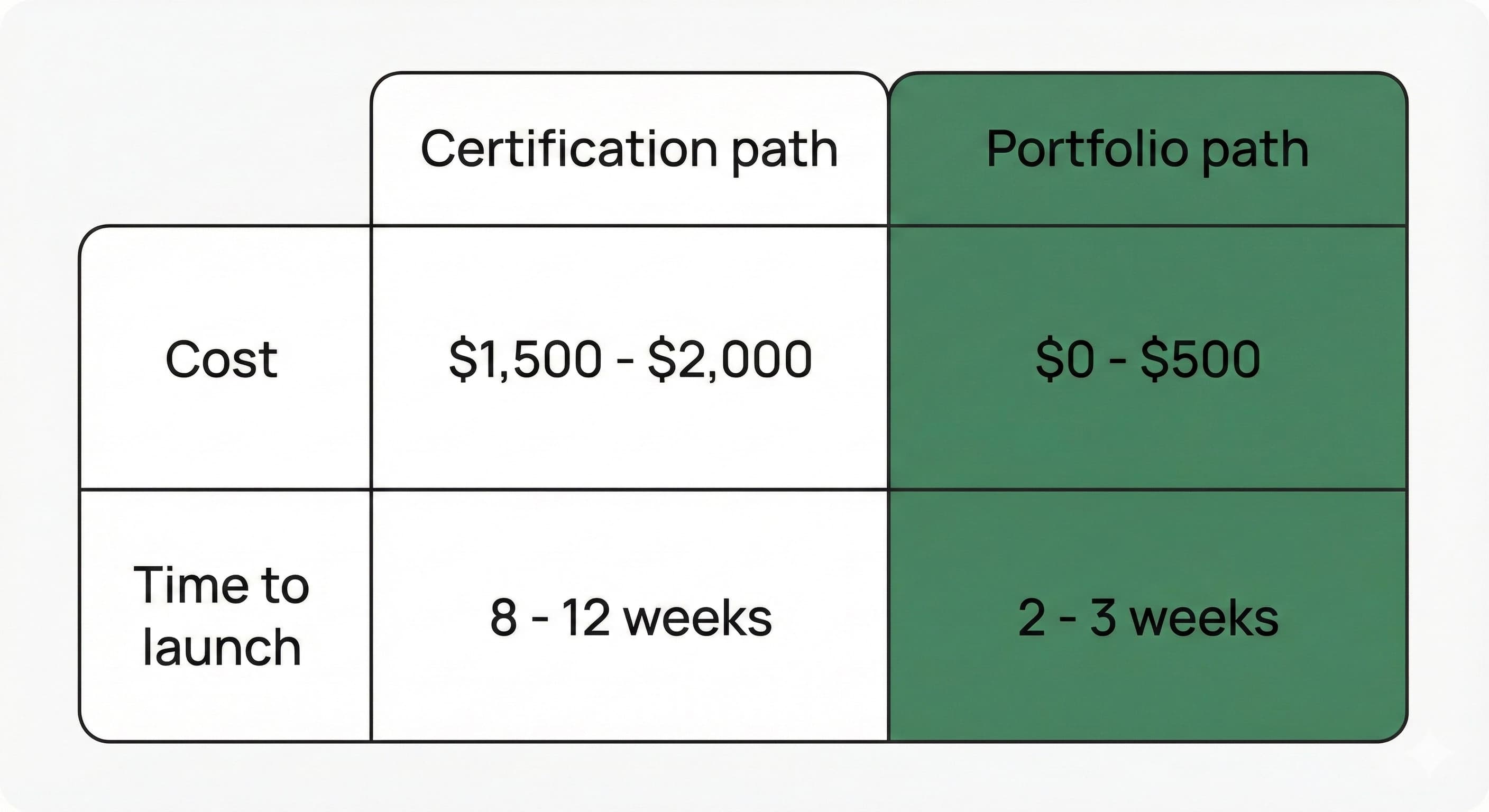
The certification path: Programs like the American Association of Certified Wedding Planners cost $1,500-$2,000 and take 8-12 weeks to complete. You get structured curriculum covering design principles, vendor management, timeline creation, and contract basics. The benefit: you learn established systems and get access to a network of other planners. Lovegevity's Wedding Planning Institute offers a similar program at $500-$1,500 with self-paced online learning.
The portfolio path: You can build credibility without spending thousands. Organize styled shoots where you partner with a photographer and vendors to create wedding-inspired scenes specifically for portfolio photos. Assist established planners for 1-3 weddings to learn the process. Plan a friend or family member's wedding using professional processes – signed contract, detailed timeline, vendor coordination – and document everything.
How do you decide? Choose certification if you want structured curriculum and industry connections. Choose the portfolio path if you learn by doing and want to start booking clients immediately without the 2-6 month delay of coursework.
Don't waste $3,000 on certification before you have your first client. Get one wedding under your belt first, even if it's for a friend. Then you'll know what skills you need to develop.
There's also a middle ground: short workshops and 1-2 day courses ($200-$500) that teach specific skills like contract law or floral design without the full certification cost.
The answer to "can I become a wedding planner with no experience?" is yes. Many successful planners never pursued formal certification. What matters more is proving you can execute a beautiful, smooth wedding day.
Your 6-step wedding planner business launch plan
What's literally the first thing to do? Every step in order:
Step 1: Choose your business structure
Most wedding planners should form an LLC rather than operating as a sole proprietor. An LLC (Limited Liability Company) is a business structure that legally separates your personal assets from business debts and lawsuits. If a client sues you, they can only go after business assets, not your house or personal savings.
As a sole proprietor, you and the business are legally the same entity. You have unlimited personal liability for business debts and lawsuits.
If you're planning a $75,000 wedding and a major vendor you recommended goes bankrupt days before the event, the couple could sue you. With an LLC, they can only pursue business assets. As a sole proprietor, your personal savings and home are at risk.
Forming an LLC costs $50-$500 depending on your state and takes 1-2 weeks. The SBA provides detailed guidance on choosing between an LLC and sole proprietorship to help you make the right call.
Step 2: Get your EIN and register your business
An EIN is your business's Social Security number. It's a 9-digit tax ID from the IRS. You need it to open a business bank account, hire employees, and file business taxes.
Getting an EIN is free, takes 10 minutes online, and you receive it immediately. You can apply for your EIN for free directly through the IRS website. Visit the site, answer 10-15 questions about your business, and receive your EIN confirmation via email.
Business name registration varies by state and county. Check your local requirements for registering your business name and obtaining any necessary licenses.
Step 3: Get liability insurance (non-negotiable)
Liability insurance is business insurance that protects you if you're sued for property damage or injury at an event. $1 million in general liability coverage typically costs $300-$600 annually and is mandatory (varies by location, business size, and coverage details).
A guest trips over a cable at the reception you planned and requires surgery. Without insurance, you're personally liable for $50,000+ in medical bills and legal fees. A centerpiece catches fire and damages the venue. A vendor you hired no-shows and the couple sues you for breach of contract.
Any of these scenarios could bankrupt your business – or worse, cost you your personal assets. Get insured before your first client meeting.
Step 4: Set up your business finances
Open a business bank account immediately and separate business and personal finances from day one. This simplifies taxes and looks professional to clients.
When you land your first client, you'll need to deposit their payment into a business account and pay vendors from that same account. This creates a clear paper trail for tax time and proves you're running a legitimate business, not a hobby.
Step 5: Create your contract
Your client contract is the legally binding document that outlines your services, payment terms, cancellation policy, and responsibilities. Never plan a wedding, even for a friend, without a signed contract.
Your contract needs to cover payment schedule, cancellation policies, liability limits, vendor coordination, timeline responsibilities, and dispute resolution. Start with a legally reviewed contract template from reputable sources like LegalZoom or LawDepot, then customize it to fit your specific business needs.
Wedding planning contract checklist
We've created a checklist with 10 essential contract clauses to provide you with guidance to ensure your contract protects you and your business. There are also a set of contract do's and don't that give you professional best practices.
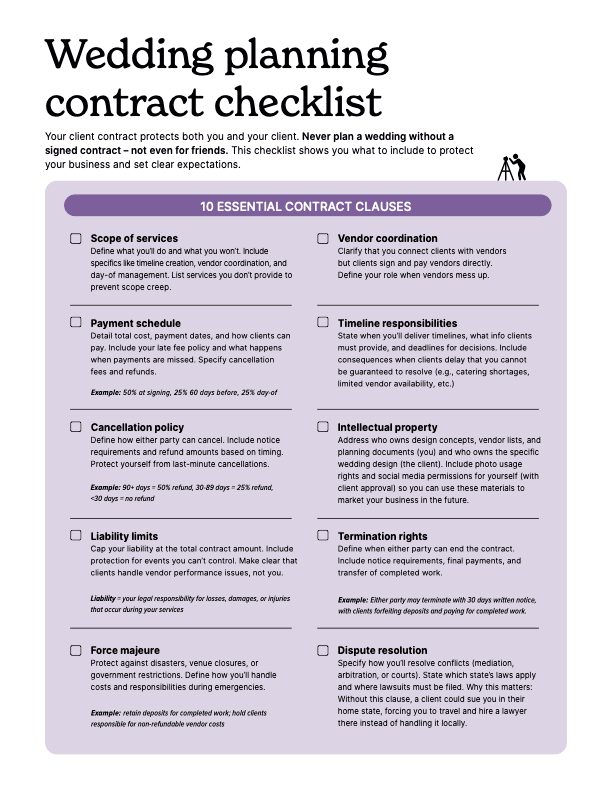
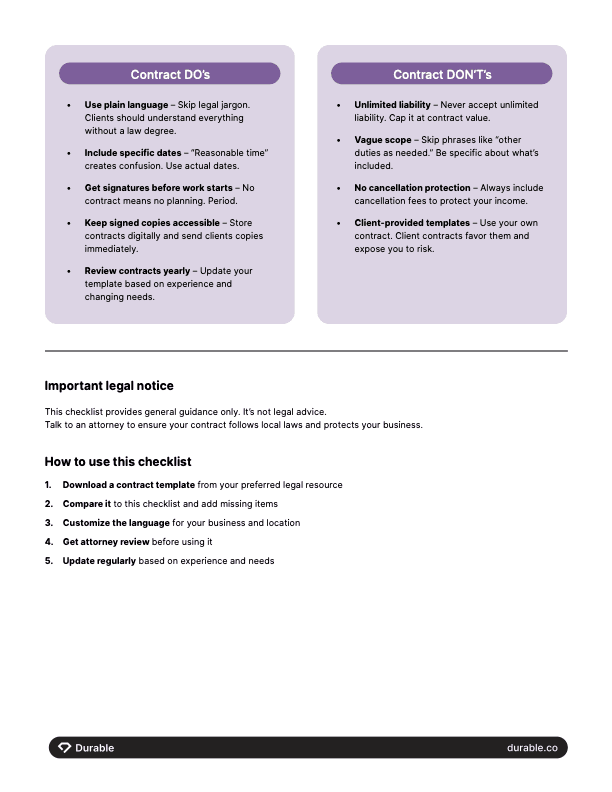

Wedding planning contract checklist

Step 6: Create your business plan
Your business plan doesn't need to be a 40-page MBA document – one page is enough to start. This is a simple roadmap for your business covering who you'll serve, what you'll charge, and how you'll find clients. The SBA offers free business plan templates to get you started.
Build your portfolio with zero experience (3 options)
The most common question aspiring planners ask is how to become a wedding planner with no experience.
1. The styled shoot
A styled shoot is a collaborative photoshoot where you partner with a photographer, florist, and rental company to create a wedding-inspired scene specifically for portfolio images. You design and execute the entire setup, and everyone gets professional photos for their portfolios.
Start by reaching out to photographers and vendors in your area who are also building their books. Search Instagram for new photographers using tags like #[yourcity]weddingphotographer. Propose splitting costs – you might pay $200-300 for your share of rentals and flowers, a fraction of planning a real wedding. You'll walk away with 30-50 professional photos showing your design aesthetic and coordination skills.
2. The assistant
Contact 10-15 established wedding planners in your area and offer to assist for 1-3 weddings for free or low cost. How to become a wedding planner assistant: Send a simple email explaining you're new to the industry, want to learn, and are available to help with whatever they need on event days.
During those weddings, take photos of your work (with permission), observe the full process, and ask for a testimonial afterward. You'll learn more from one real wedding than from months of online courses.
3. The "pro-bono-pro"
Plan a friend or family member's wedding using real professional processes. This isn't just "helping out" – you create a signed contract, detailed timeline, vendor coordination sheets, and day-of execution plan. Treat it like a paying client, document everything, and get a professional testimonial.
Your portfolio needs 8-15 quality images showing your planning style and execution capability. Once you have those images, create a simple website or Instagram account showcasing your work (more on this in the next section).
5 essential wedding planner business tools
New wedding planners waste weeks researching tools. You need five.
Tool 1: Your business hub (website, CRM, invoicing)
You need three things up front: a professional website so clients take you seriously, a CRM to track potential customers and manage client information, and invoicing to get paid.
Building a website doesn't have to take weeks or cost thousands. Durable's AI website builder can create your professional site in minutes and includes your CRM and invoicing tools in the same platform. You can have everything set up in 3 minutes.
Your website also needs a professional logo that communicates your style to engaged couples. Create your wedding planning logo in minutes using AI in Durable – no design experience required. This logo was created using the simple prompt: "Elegant, modern logo for wedding planning business, soft romantic colors, minimal text."
Tool 2: Your planning and timeline tool
Once you book a client, you need wedding planner client management software to handle event timelines, vendor schedules, and day-of logistics. Tools like Aisle Planner handle timelines and floor plans specifically for wedding professionals. These platforms let you build minute-by-minute schedules, share them with vendors, and access them on your phone during the event.
Tool 3: Your mood board and design tool
Clients need to visualize their wedding aesthetic. Canva creates professional mood boards and client presentations without design skills. Canva templates go beyond Pinterest, making it easy to create stunning vision boards, color palettes, and style guides that make you look like a pro.
Tool 4: Your communication hub
End the amateur Gmail address. Set up professional email through Google Workspace to get a custom domain email (you@yourweddingcompany.com instead of yourname@gmail.com). Professional email addresses signal credibility the moment someone receives your first message.
Tool 5: Your contract and document storage
Use DocuSign or similar services for contract signing, and Google Drive or Dropbox for organizing client files. Keep every contract, timeline, and vendor agreement in clearly labeled folders so you can find anything in seconds.
Your business hub (website, CRM, invoicing) connects to everything else. When a lead inquires through your website, they go into your CRM. When you book them, you send a contract and invoice. When you're coordinating vendors, you share timelines from your planning tool. It all works together.
How to get your first paying clients as a wedding planner
You've set up your business, built your portfolio, and launched your website. Now comes the hardest part: getting someone to pay you.
Set realistic expectations: Your first client will probably come several months after you've started your business through your immediate network or vendor referrals. Few new planners land clients from cold marketing.
Strategy 1: Use your portfolio
Share your styled shoot or portfolio wedding across social media and your personal network. Don't say "I'm new." Say "I just planned [friend's name]'s wedding and here's what it looked like." Frame yourself as someone who's done this work, because you have.
Post those photos to Instagram with location tags and relevant hashtags. Your friends will see it, share it, and suddenly you're "the wedding planner friend" in their network.
You don't need Photoshop skills to create scroll-stopping portfolio posts. Use AI tools to design professional social posts in seconds that showcase your work.
Strategy 2: Partner with vendors
Reach out to 10-15 photographers, florists, and venues in your area. Offer to give their clients 10% off planning services for your first 5 bookings. They get an exclusive selling point ("Book with us and get 10% off planning!"), and you get warm referrals from trusted sources.
Vendor referrals are your best lead source. Photographers refer planners they trust to couples all the time. Be the planner they trust by doing great work on your portfolio projects and building genuine connections.
Strategy 3: Local wedding Facebook groups
Join 3-5 wedding-related Facebook groups in your area where engaged couples ask questions. Don't spam your services. Instead, provide genuinely helpful advice when people ask about timelines, vendor recommendations, or day-of logistics.
After giving great free advice, mention: "If you need help pulling this together, I'm booking 2025 weddings – feel free to DM me."
Strategy 4: Wedding shows and open houses
Attend local bridal shows as an attendee first to meet vendors and understand the market. When you're ready to invest $200-400, split a booth with another new vendor (photographer, florist) to cut costs and meet engaged couples actively looking for services.
Strategy 5: Set up a Google Business Profile
A Google Business Profile is essential – it's how local couples find wedding planners when searching "wedding planner near me," otherwise known as "local SEO". It doesn't take long to set up. Add photos from your styled shoots, gather your first reviews from portfolio clients, and include your service areas. Many new planners get their first inquiries through Google within 60 days of setup.
Your first 5 clients often come from friends of friends, vendor referrals, or people who already have some reason to trust you. Focus there before investing in paid advertising or cold outreach.
Frequently asked questions about becoming a wedding planner
How do you become a wedding planner?
Start by deciding between forming an LLC ($50-500) or operating as a sole proprietor, then get your free EIN from the IRS and purchase liability insurance ($300-600 annually). Build your initial portfolio through styled shoots, assisting established planners, or planning a friend's wedding professionally. Set up your business website and basic tools for client management and invoicing. Most new planners launch within 30-60 days and book their first paying client within 3-6 months.
What's the fastest way to become a wedding planner?
The fastest path is the portfolio route. Skip certification (saves 2-6 months and $500-$3,000), plan a friend or family member's wedding professionally with a real contract and timeline, and start booking paid clients within 2-3 months. Get your LLC, EIN, and insurance done in the first two weeks while you're lining up that first portfolio wedding. Document everything, get professional photos, and you're in business.
Do wedding planners make money?
Yes. Wedding planners earn $40,000-$75,000+ annually, with income potential increasing significantly as you build your client base. Day-of coordination services run $1,000-$3,000 per event, while full-service planning packages range from $3,000-$10,000+. According to the Bureau of Labor Statistics, the median salary for event planners is $59,440, but specialized wedding planners often exceed this.
How long does it take to become a wedding planner?
You can launch your wedding planning business within 30-60 days. The legal setup (LLC formation, EIN, insurance) takes 1-2 weeks. Building your initial portfolio through styled shoots or assisting other planners takes 4-8 weeks. Most planners book their first paying client within 3-6 months of launching and reach full-time income potential within 12-24 months.
What degree do you need to become a wedding planner?
No degree is required – wedding planning is an unregulated profession in all 50 states. Many planners pursue optional certifications like AACWP ($1,500-2,000) or Lovegevity ($500-1,500) for structured training and industry credibility. You can also build your career through portfolio development and hands-on experience without formal certification.
Is it good to take wedding planning courses or start working in the field?
Both paths work – it depends on your learning style and budget. Certification courses ($500-$3,000) provide structured curriculum and industry connections but add 2-6 months before you can book clients. The portfolio-building path (styled shoots, assisting established planners) costs less ($0-500) and lets you start booking paid clients within 2-3 months.
What business structure should I choose?
Most wedding planners should form an LLC rather than operating as a sole proprietor. An LLC costs $50-500 to set up depending on your state and protects your personal assets if you're sued. As a sole proprietor, clients can pursue your home, car, and personal savings in a lawsuit – too risky for an event-based business.
How much does it cost to start a wedding planning business?
Expect startup costs of $1,000-$3,000, which includes: business formation ($50-500), liability insurance ($300-600 annually), professional website ($0-500), business cards and marketing ($200-500), and contract templates ($0-200).
Where most new wedding planners hit a wall
You've got the roadmap – now comes the action. Most new planners spend weeks perfecting their setup instead of booking their first client.
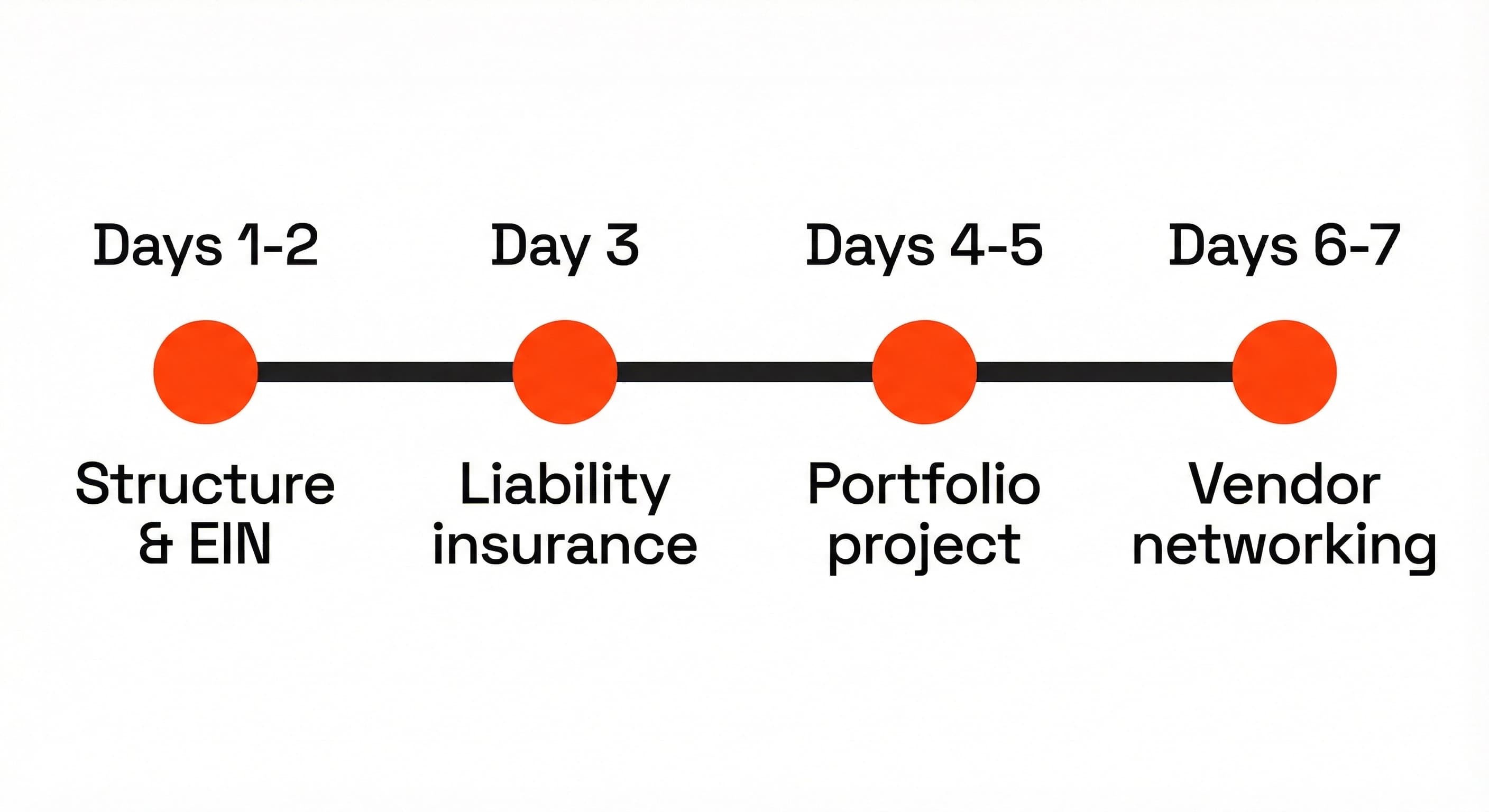
Your 7-day launch plan:
- Days 1-2: Set up your business structure and get your EIN
- Day 3: Buy liability insurance
- Days 4-5: Plan your first portfolio project
- Days 6-7: Connect with local vendors for partnerships
Focus on progress, not perfection. Your first client will come from your network or a vendor referral, not from having the perfect website.
If you want to handle the business basics quickly, Durable can set up your website, client management, and invoicing in minutes.
But the most important thing? Start this week.
The wedding industry needs planners who genuinely care about creating stress-free celebrations. Stop researching how to become a wedding planner – start planning (weddings).
If you're still exploring different entrepreneurial paths, check out our guide to small business ideas to see how wedding planning compares to other careers.
Disclaimer: This article provides general information about starting a wedding planning business and does not constitute legal, financial, or professional advice. Business requirements vary by state and locality. Consult with a qualified attorney and accountant for guidance specific to your situation.