Affordable SEO services for small business cost anywhere from $0 (doing it yourself) to $3,000+ per month for real agency work. Ultra-cheap options that sell services for $300/month or less often use spam tactics that trigger Google penalties and cost more to fix than quality SEO costs upfront.
SEO stands for Search Engine Optimization - it's the work that helps your website show up when people search Google for what your business offers. It's important, complicated, and can cost a lot. Using shady or amateur DIY tactics can cost even more.
Learn how to avoid scams, what expert work that gets your business on page one of Google actually costs, and how to use AI tools for technical work without the agency price tag.
Why $99 agencies aren't actually affordable SEO services for small business
The average SEO consultant in the US charges $100 - $150 per hour, according to industry surveys. A $99 monthly fee buys you less than 45 minutes of actual work. That's not a lot of time for any real SEO work.
So what are these ultra-cheap agencies actually doing? Three possibilities, and all of them are bad.
- Outsourcing to overseas contractors who use auto spam tools. Even real offshore work requires someone to manage it. If someone's charging $99 total, nobody's managing anything.
- Running black hat link schemes through fake website networks (called Private Blog Networks or PBNs). These are collections of low-quality websites built just to manipulate search rankings. These tactics violate Google's spam policies and can result in permanent penalties for your business.
- Literally nothing and hoping you don't notice for a few months.
Watch for this red flag: your credit card shows a different company name than the one you hired. This shell game makes it nearly impossible to dispute charges or hold anyone accountable when the "work" destroys your search rankings instead of improving them.
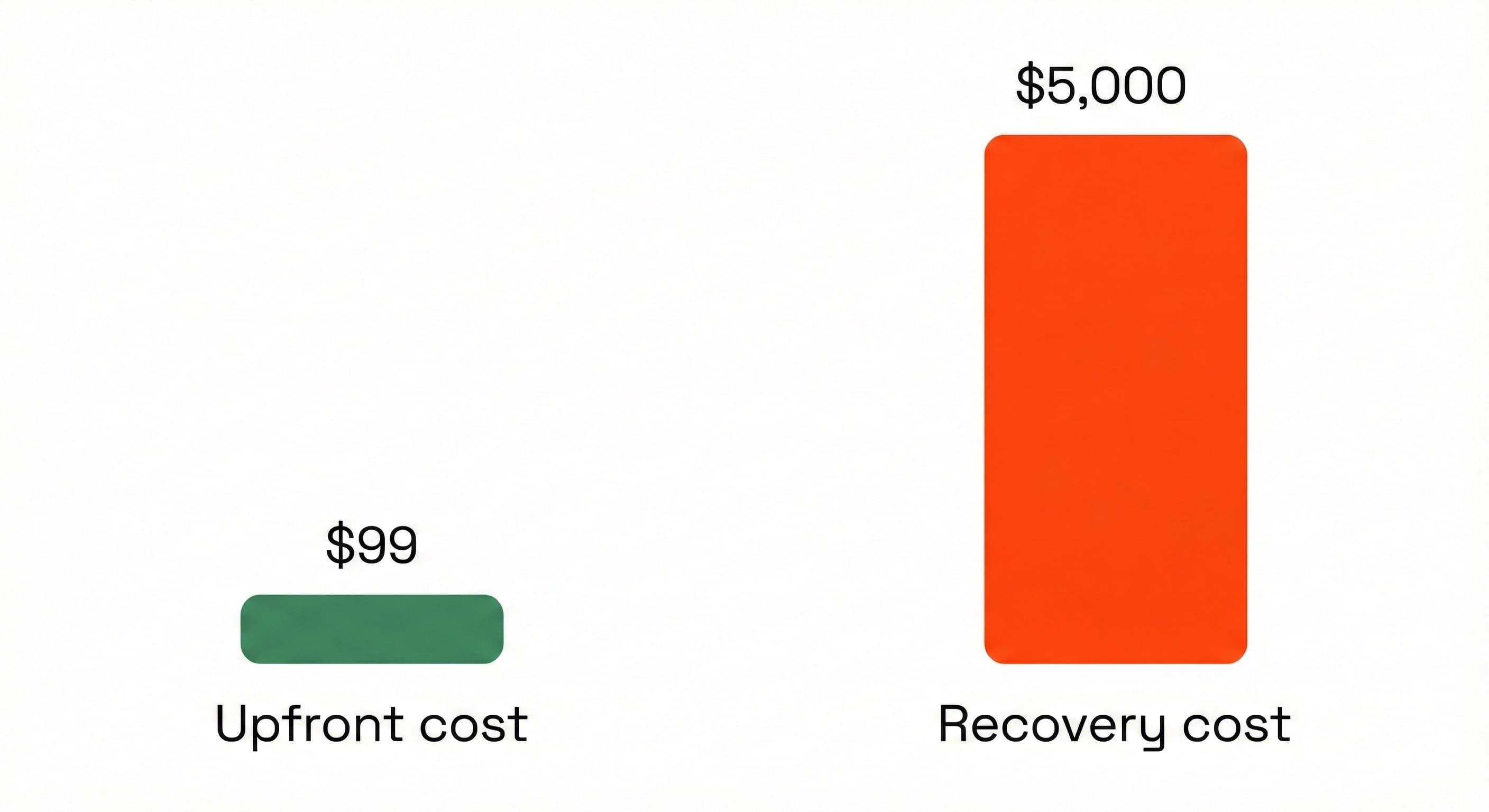
The hidden cost of cheap SEO is very high. Getting hit by a Google penalty can cost 10 times more than real SEO would have cost upfront.
You'll need to hire an expert to review your site and find all the bad backlinks. Then you submit a file to Google asking them to ignore those links. After that, you rebuild your content from scratch and hope Google gives you another chance. We're talking $5,000–$15,000 in recovery costs to fix a $99 mistake.
Affordable SEO Services: 5 red flags your "affordable" agency is a scam
You need to protect yourself. The affordable SEO market is full of scammers who prey on small business owners who don't know what real SEO looks like. Watch for these five red flags that signal you're dealing with a bad actor.
Red flag #1: "Guaranteed rankings"
If an agency promises to get you to #1 on Google, they're lying. Google explicitly warns against guaranteed rankings in their own documentation.
No SEO pro can guarantee rankings because they don't control Google's algorithm. Real consultants will say things like "we expect to improve your rankings over 3–6 months based on competitive analysis" or "our goal is to increase organic traffic by 30%." They focus on metrics they can influence, not outcomes they can't control.
Red flag #2: "Proprietary technology"
This is usually code for "we won't tell you what we're doing" or "we're running a black hat bot network." Real SEO is not secret.
Google publishes their guidelines. The tactics that work are well-documented and widely taught. If an agency claims their "proprietary system" delivers results others can't, they're either lying about their effectiveness or using link schemes that will eventually trigger a Google penalty.
Red flag #3: Mismatched billing names
Check who actually bills your credit card. If the company name you see in ads doesn't match the company that charges your card on your statement, that's a massive red flag for accountability.
Real businesses bill under their actual company name. Scammers use shell companies to make it harder for you to dispute charges or pursue legal action when their "SEO services" destroy your site instead of improving it.
Red flag #4: Generic reports with no specific actions
Watch out for vague monthly reports. If they just list "directory submissions" or "link building" without showing you exactly where, you're being scammed.
Real work comes with proof. Your consultant should send you direct links to every listing, every new backlink, every piece of content published.
If they can't show you the actual work, the work probably doesn't exist.
Red flag #5: Gmail addresses
Expert agencies have domain-based email addresses (name@agencyname.com). Watch out for SEO sellers using Gmail or Yahoo addresses. They're likely solo operators doing high-volume sales. They don't plan to deliver real results.
Real businesses invest in basic setup.
Small business SEO agency pricing
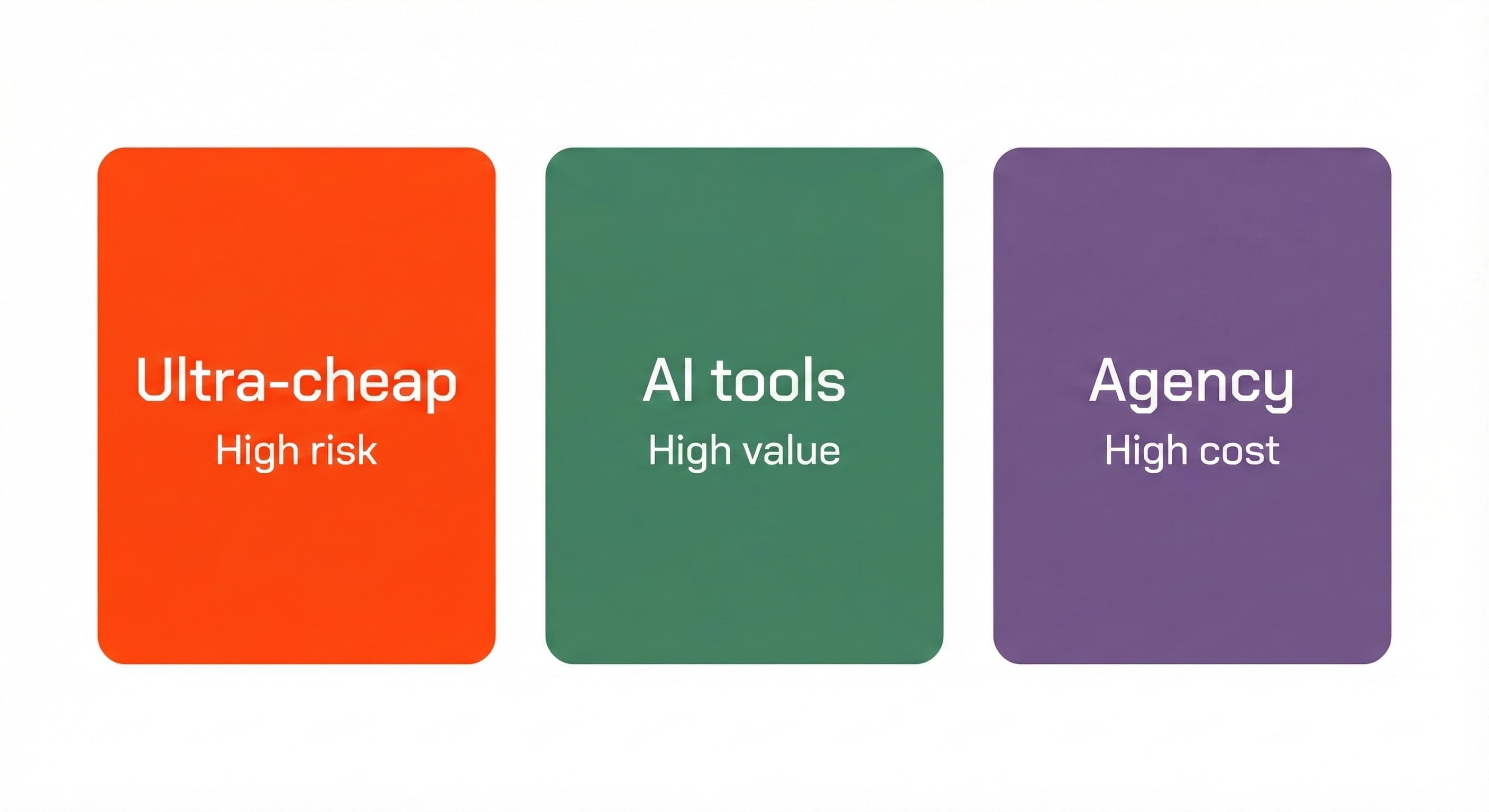
Stop thinking about SEO as one category. The market breaks into five distinct tiers. Each has different numbers and risk profiles.
Understanding where you fit helps you avoid dangerous options. It also helps you find real solutions for your actual budget.
Tier 1: Ultra-cheap ($99–$300/month) – High risk, low cost
These are the auto spam factories and PBN link schemes we just discussed. The numbers don't support real work at this price point.
You'll get generic listings, low-quality guest posts on spam sites, and maybe some keyword-stuffed blog posts written by AI with zero strategy behind them.
The only verdict here: avoid completely. The risk of Google penalties isn't worth saving $200 compared to real options. These are not actually affordable SEO services for small business.
Tier 2: DIY ($0 + Your Time) – High effort, low cost
This is you doing the work yourself using free tools and tutorials. It's safe — you won't accidentally build spammy backlinks or trigger penalties. But it's very slow.
Expect to spend 5–10 hours a week learning SEO basics, improving your site, creating content, and managing your Google Business Profile.
The verdict: good for starters who have more time than money and are willing to invest months learning the basics.
Tier 3: AI Tools ($20–$50/month) – High value, low cost
This is the AI breakthrough. Platforms like Durable handle expert technical SEO on their own. SSL certificates, site speed improvements, making sure your site works well on phones, structured data, and automatic sitemaps.
AI generates and publishes content at a speed no human writer could match for the price. You get the technical setup that agencies charge $1,500/month to manage. But it's delivered by software instead of consultants.
The verdict: best value for small business owners who need expert setup without the agency price tag.
Tier 4: One-time projects ($1,000+/project) – High value, high cost
Instead of renting an agency's time with monthly fees, you pay a pro to fix specific problems (often over $1,000 for a one-off project). A technical checkup to find site issues. Google Business Profile verification and setup. Citation cleanup to ensure your business name, address, and phone number (NAP) are consistent across the web.
The verdict: high impact for businesses with some budget who want to own the improvements instead of renting ongoing access.
Tier 5: Full-service agencies ($1,000–$3,000+/month) – Low risk, high cost
This is professional SEO work done by real humans with proven track records. Custom strategies, dedicated account managers, monthly reporting, and comprehensive link building campaigns.
You get expertise, accountability, and results. But you pay premium prices (typically starting around ~$1,000/month) for premium service.
The verdict: best for established businesses with bigger budgets who need comprehensive SEO management and can afford ongoing monthly fees.
Tier | Monthly cost | Risk level | Value | Best for |
Ultra-cheap | $99–$300 | High Risk | Negative | Nobody — avoid completely |
DIY | Free | Low Risk | High | Those with time to learn basics |
AI tools | $20–$50 | Low Risk | Very High | Small businesses needing technical SEO |
One-time projects | $1,000–$5,000 (one-time) | Low Risk | High | Businesses wanting to own improvements |
Full-service agencies | $1,500–$3,000+ | Low Risk | Medium | Established businesses with large budgets |
Most small business owners should combine Tier 2 and Tier 3. Use AI tools for the technical setup. Then add your own work for local content and Google reviews.
If you have budget for a one-time investment, Tier 4 projects can accelerate your results without the ongoing spending of Tier 5 agencies.
The new standard for affordable SEO services: AI tools vs. cheap labor
The reason small business owners search for "affordable" SEO is simple. They want tools to make expert-quality work accessible at low prices.
Until recently, that wasn't possible.
Every SEO task — from writing meta descriptions to generating XML sitemaps — required a human. Agencies charged for that human's time. That meant small budgets bought small results.
Generative AI changed the equation completely. You don't need to pay someone $500 to write meta tags. AI can create keyword-targeted descriptions for every page on your site in 30 seconds.
You don't need to pay an agency $200/month to make your site load fast. AI website builders handle speed, security, and mobile setup for you. No ongoing cost.
Consider content creation speed. A traditional SEO agency writes one blog post per month for $500–$800. AI can create unlimited blog posts for a flat subscription fee. You provide the subject expertise and final approval. But the AI handles the research, outlining, and first draft work that used to eat up most of the cost.
Google itself says AI-generated content on your site is perfectly acceptable as long as it serves your audience's needs.
The technical SEO category sees the biggest change. Things like schema markup (structured data that helps Google understand your site), site speed improvements, and works well on phones used to require expensive technical audits and developer work.
AI website builders like Durable handle all of this on their own. Your site is built mobile-first. It loads in under two seconds. It includes proper structured data from day one. These are expert features that agencies bill thousands to implement. Now they're included by default because software handles it better than humans ever could.
To be clear, Durable isn't just a website builder. It's an auto SEO analyst. The platform does keyword research, publishes SEO-ready content, and manages site speed. It keeps your site in line with Google's SEO guidelines. You don't need to understand any of it. You focus on running your business. The AI handles the search engine work that used to require either expensive agencies or months of DIY learning.
The "sprint" strategy: buy assets, not time
Monthly fees are a tough sell for small business owners with unpredictable cash flow. You're paying for access to an agency's time. If you cancel, you lose that access. Meanwhile, the work they did often requires ongoing care. That means you're locked into the subscription.
There's a smarter approach: buy assets, not time. Stop renting SEO and start building permanent improvements to your online presence.
The "sprint" model works like this. You hire a pro once to fix specific, measurable problems. They deliver the work. You verify it's done correctly. You own the results forever. No ongoing fees. No lock-in. Just tangible improvements you can see and measure.
If you have $1,000 to spend on a one-time SEO investment:
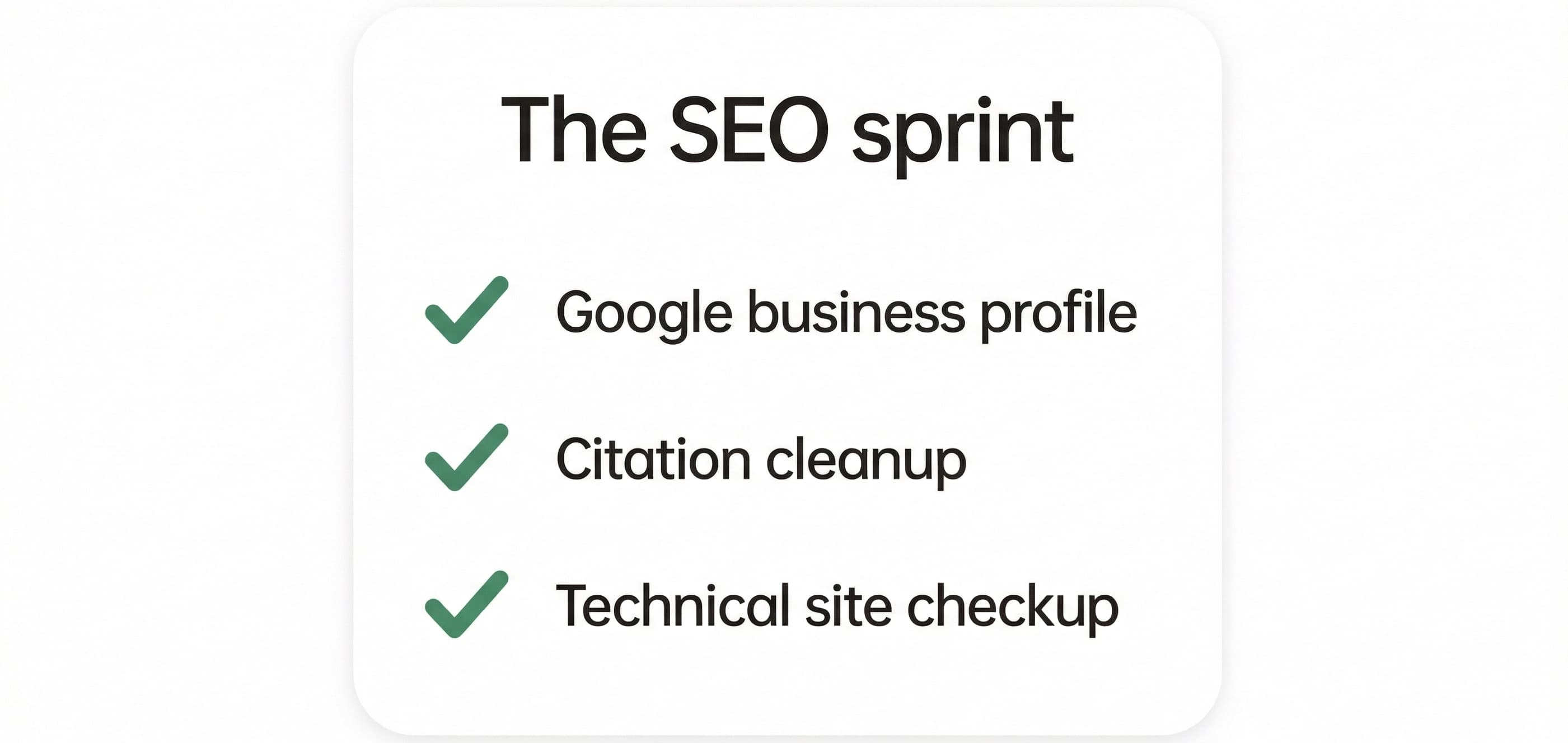
• Google Business Profile verification and setup – This is your listing in the Map Pack (the three local businesses that appear at the top of Google when someone searches for services near them). A pro can verify your listing, set up your categories, write your description, and upload photos. They'll adjust all the settings Google uses to pick which businesses to show. You can also manage your Business Profile yourself if you have the time. Cost: $200–$400. This pays back right away in phone calls and direction requests.
• Citation cleanup and NAP consistency – Your business name, address, and phone number (NAP) need to be identical across every listing where you appear online. A directory is a website that lists local businesses. Mistakes confuse Google and hurt your local rankings. A citation cleanup service finds all your listings, corrects errors, and ensures consistency. Cost: $300–$600 depending on how many listings need fixing.
• Technical site checkup and fixes – A pro audit finds specific problems hurting your SEO: slow page load times, broken links, missing meta descriptions, poor mobile experience, security issues. The consultant delivers a list of fixes in order of importance. Often they can implement the critical ones. Cost: $500–$1,000 depending on site complexity.
The sprint strategy wins for three reasons.
First, you can verify the work was actually done. Your Google Business Profile is either set up or it isn't. Your NAP citations are either consistent or they're not.
Second, the improvements are finite. You're not paying month after month for "ongoing work" that may or may not be happening.
Third, sprints fit unpredictable cash flow. Save up $500, buy an asset, measure the results. Then decide if you want to invest more.
Essential SEO: what actually works
If you're doing SEO yourself or using AI tools, you need to know what actually matters. Most SEO advice online is either outdated or written for big companies with resources you don't have. Focus on what actually works for local service businesses.
Focus on local rankings, not national rankings
Ignore advice about "ranking #1 for [broad keyword]." You're not competing with national brands. You're competing for the Map Pack — the three businesses Google shows when someone searches for "plumber near me" or "house cleaning service in [city]." Local SEO is a completely different game with different ranking factors.
Build dedicated service pages
Don't list all your services on one page and hope Google figures it out. If you're a plumber who does emergency repairs, drain cleaning, water heater installation, and bathroom remodeling, you need four separate pages.
Each page should target the specific search people use for that service. "Emergency plumber [city]" gets its own page. "Drain cleaning [city]" gets its own page. Google ranks pages, not websites. So give Google a clear page to rank for each thing you do.
Get Google reviews religiously
This is the single biggest "free" ranking factor that actually works. According to Google's local search ranking factors, review quantity, recency, and sentiment play a big role in local rankings.
A business with 50 reviews from the last six months will outrank a business with 5 reviews from two years ago. This is true even if the second business has better SEO otherwise. After every job, ask satisfied customers to leave a review. Send a follow-up text with a direct link to your Google Business Profile review page. Make it easy.
Fix your site speed
If your website takes more than three seconds to load, you're losing customers before they even see your content. Google's Core Web Vitals made page speed a direct ranking factor. Slow sites get demoted. Fast sites win.
If you're using an AI website builder like Durable, this is handled for you. If you're on an old platform or a slow shared hosting provider, site speed alone could be killing your rankings.
These four actions — local focus, dedicated service pages, Google reviews, and site speed — deliver 80% of the SEO results small businesses actually need. Everything else is refinement around the edges. Master these basics before worrying about advanced tactics like link building or technical structured data.
Get expert SEO without the expert price tag
In 2026, affordable SEO services for small business means combining DIY effort with AI platforms. This is true whether you’re a landscaper, a caterer, or still deciding which small business to start.
AI website building tools like Durable handle the technical foundation — site speed, SSL certificates, structured data, mobile optimization — automatically. That's the expensive part agencies charge $1,500+ monthly to manage.
You add your own time for the work that actually requires human judgment: creating local content, collecting Google reviews, and understanding your customers.
This combination gives you expert technical setup without SEO agency pricing. And you avoid both the $99 scams and the overwhelming time sink of pure DIY.
If you're still in the planning stages of your business or looking to expand your offerings, exploring different service business ideas can help you identify profitable services to feature on your site.
Affordable SEO services FAQs
Should I do my own SEO?
Yes, if you're willing to invest time learning the basics. Start with Google's SEO Starter Guide, which explains what Google actually wants from websites. Focus on local SEO basics: claim and set up your Google Business Profile, build dedicated pages for each service you offer, collect reviews after every job, and ensure your site loads fast on mobile.
These core tactics will deliver results without requiring advanced technical knowledge. Budget 5–10 hours per week for the first three months while you're learning. Then 2–3 hours per week for ongoing care.
How much should small business SEO cost?
It depends on whether you're buying time or buying tools. Monthly agency fees for real work start around $1,500–$3,000 and go up from there. One-time project work (like a technical audit or Google Business Profile setup) ranges from $500–$2,000 depending on scope.
The most affordable SEO services for small business are AI platforms that handle technical SEO on their own cost $20–$50 per month. DIY is free but costs your time. Avoid anything under $300/month that promises full SEO — the numbers don't support real work at that price.
Is AI SEO good?
AI is excellent for technical and structural basics. Auto platforms handle things like site speed improvements, works well on phones, SSL certificates, XML sitemaps, and structured data better than humans. These are code-based tasks with clear right answers.
AI is also strong at content generation - writing meta descriptions, creating first drafts of blog posts, suggesting keywords. Where AI still struggles is strategic thinking and understanding local market nuances. The best approach combines AI for technical heavy lifting with human judgment for strategy and brand voice.